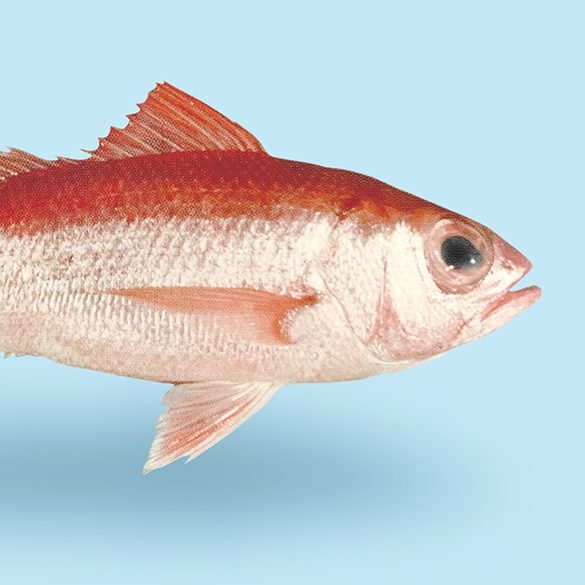


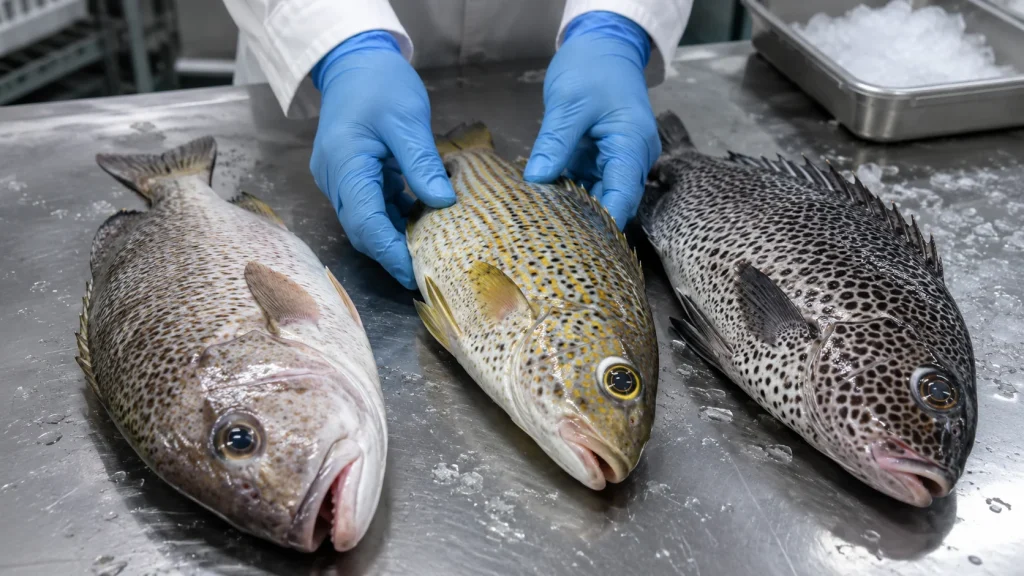
If you buy or source seafood internationally, names such as “sweetlip,” “sweetlips,” and “sweetlip snapper” can look interchangeable. They do not always refer to the same fish.
The confusion comes from the way fish names vary across taxonomy, local fisheries terminology, export documentation, and commercial seafood markets. “Sweetlips” commonly refers to a group of fishes in the family Haemulidae, including species of Plectorhinchus and Diagramma. “Sweetlip” is widely used as a singular commercial name for these fish. “Sweetlip snapper,” however, can refer to a true snapper in the family Lutjanidae in some regional naming systems.
For seafood buyers, this means the product name on a quotation is only a starting point. If species identity matters for labeling, import requirements, product specifications, or quality control, the scientific name should also be checked.
Sweetlip and sweetlips usually refer to a group, not one species
“Sweetlips” is commonly associated with fishes in the family Haemulidae. The U.S. Fish & Wildlife Service, for example, uses the name for fishes in the genus Plectorhinchus. Fisheries identification references also include Diagramma species within the broader group commonly known as sweetlips or grunts.
This matters because “sweetlips” is not the name of a single species. Several fish can legitimately carry a sweetlips common name while differing in coloration, body proportions, distribution, and other biological characteristics.
Examples include species such as Plectorhinchus lineatus, Plectorhinchus orientalis, Plectorhinchus vittatus, and Diagramma pictum. Depending on the country and naming system, individual species may also be called Oriental Sweetlips, Ribbon Sweetlips, Painted Sweetlips, Spotted Sweetlips, or other more specific common names.
The U.S. FDA Seafood List shows this variation clearly. Several Plectorhinchus species can use “Grunt or Sweetlips” as an acceptable U.S. market name. Diagramma pictum is also listed as “Grunt or Sweetlips,” while Diagramma labiosum is treated differently, with “Grunt” as the acceptable market name and “Sweetlips” listed as a common name.
So when a supplier offers “sweetlips,” the name may identify a broad commercial group without telling you exactly which species is being supplied.
Is there a difference between sweetlip and sweetlips?
In seafood trade, the difference is often grammatical rather than biological.
“Sweetlips” appears frequently in fisheries references and common-name databases as the name of a fish or fish group. “Sweetlip” is commonly used as the singular commodity name in supplier catalogs, export records, and purchasing conversations.
Indonesian trade documentation provides a useful real-world example. Records from Indonesia’s Ministry of Marine Affairs and Fisheries in 2025 use SWEETLIP as a seafood product description in export documentation.
In one record dated February 28, 2025, SWEETLIP and WHITE SNAPPER were listed separately on the same shipment. Other Indonesian export records also distinguish SWEETLIP from snapper categories such as Tropical Snapper.
This does not mean every exporter, buyer, or country uses the terminology in exactly the same way. It does show that “sweetlip” is an established commercial term and that, in Indonesian seafood trade, it can be treated as a product category separate from snapper.
The spelling difference alone should therefore not be used to assume that “sweetlip” and “sweetlips” refer to different fish.
| Name | What it commonly indicates | Is it one exact species? |
|---|---|---|
| Sweetlip | Commercial or singular form used for sweetlip fish | No |
| Sweetlips | Common group name, especially for Haemulidae such as Plectorhinchus and Diagramma | No |
| Sweetlip snapper | A regional common name that may refer to a true Lutjanus snapper | Not reliably from the name alone |
Sweetlip snapper is more complicated
It would be easy to assume that “sweetlip snapper” simply means a sweetlip fish marketed as snapper. Authoritative fish-name databases show that the term can mean something different.
FishBase records “Sweetlip snapper” as a South African common name for Lutjanus lemniscatus. Unlike Plectorhinchus or Diagramma sweetlips, Lutjanus lemniscatus belongs to Lutjanidae, the true snapper family.
The species is known by other names in other markets. FishBase records the FAO English name Yellowstreaked Snapper, while regional fisheries sources may use names such as Darktail Snapper or Dusky-tail Snapper.
As a result, someone ordering “sweetlip snapper” in one market could be referring to a true snapper rather than the haemulid fishes normally sold as sweetlip or sweetlips.
There is also some historical naming ambiguity. The Integrated Taxonomic Information System records “sweetlip snapper” in connection with Lutjanus rangus, but identifies L. rangus as an invalid junior synonym of Lutjanus bohar. Modern sources generally use other common names for L. bohar.
This does not necessarily mean one source is wrong. Common names often develop regionally and can remain in use even after scientific classifications or preferred market names change.
For seafood purchasing, however, “sweetlip snapper” is too ambiguous to confirm species identity on its own.
Sweetlips and snappers are not the same biological group
Most fish commonly called sweetlips belong to Haemulidae, while true snappers belong to Lutjanidae.
Whole fish can often be distinguished by anatomical characteristics rather than skin color alone. Fisheries identification references describe haemulids as having features such as pores on the chin and, in Plectorhinchus, characteristically thick lips. Their mouth and dental structures also differ from those of lutjanid snappers.
Color is a less reliable identification method. Sweetlip species can vary considerably in spots, stripes, background color, and markings. Juveniles and adults of the same species can also look quite different.
Identification becomes harder after processing. Once a fish has been headed, filleted, skinned, portioned, or frozen in a processed form, many of the external features used for visual identification are no longer available.
Two products with similar white flesh and portion shapes may therefore come from different species even when their trade names sound similar. For buyers purchasing processed frozen seafood, documentation becomes increasingly important as the product is processed further.
The same sweetlip name can cover different species
Another common mistake is assuming that every product sold as Sweetlip is a Plectorhinchus species. Diagramma species can also appear under the same broad trade name.
Indonesian fish-identification material, for example, identifies Diagramma labiosum as Slate Sweetlip or Slate Bream within the family Haemulidae. The species is also recognized by international biodiversity databases, although its taxonomic treatment and common naming have not always been completely uniform across regional references.
That variation matters in commercial sourcing. One Indonesian supplier may sell a product identified specifically as Diagramma labiosum under the trade name Sweetlip, while another supplier’s “Sweetlip” specification could refer to a different species.
Neither situation is necessarily unusual. The problem starts when a broad commodity name is assumed to guarantee species equivalence.
For buyers comparing quotations, price should therefore not be compared from the trade name alone. Two suppliers can both quote “Sweetlip” while offering products with different scientific names, origins, sizes, cuts, or specifications.
What should seafood buyers check when purchasing sweetlip?
For an initial product conversation, a common name such as Sweetlip is useful. Before confirming a detailed specification, buyers should go one step further.
Start with the scientific name. A Latin binomial such as Diagramma labiosum or Plectorhinchus lineatus provides much more precise identification than “sweetlip” alone.
Then check where the fish was sourced. Regional naming practices are one reason the same common name can refer to different species in different markets.
The destination market also matters. Commercial names that are familiar in Indonesia or another exporting country are not automatically accepted as regulatory or retail names elsewhere.
The FDA Seafood List shows this distinction in the United States. It separates acceptable market names, common names, scientific names, and vernacular names. A vernacular name may help identify what people call a fish locally, but that does not automatically make it an acceptable label for products marketed in the U.S.
For an importer, distributor, retailer, or foodservice buyer, a useful product specification can therefore include:
- commercial product name;
- scientific species name;
- country or catching area of origin;
- product form, such as whole round, whole gutted, fillet, steak, or portion;
- size or grading specification;
- packaging format;
- destination-market labeling requirements.
These details are especially useful when quotations from several suppliers use similar English trade names.
Why species identification can matter beyond naming
Correct fish identification is more than a terminology issue.
Species can differ in regulatory treatment, labeling requirements, biological characteristics, sourcing considerations, and food-safety risk profiles. This does not mean fish sold as sweetlip should automatically be considered risky. It means that substituting one species name for another without verification can create problems further along the supply chain.
A case reported by Germany’s Federal Institute for Risk Assessment shows why species-level identification can sometimes matter. Frozen fish involved in a ciguatera outbreak had been declared as Lutjanus malabaricus, but DNA barcoding identified the fish as Lutjanus bohar, a species associated with ciguatoxin risk.
This example should not be treated as a general warning against sweetlip. The narrower lesson for seafood procurement is that when common or historical names can point to different species, accurate identification may affect more than the product description.
DNA testing is one method available when visual identification is no longer possible. The FDA, for example, maintains seafood DNA reference information to support species identification.
For routine B2B purchasing, buyers generally begin much earlier by checking species declarations, supplier specifications, traceability records, and destination-market labeling requirements before products move through distribution.
Common names are useful, but scientific names reduce ambiguity
There is no simple rule that Sweetlip, Sweetlips, and Sweetlip Snapper are three spellings for exactly the same product.
Sweetlip and Sweetlips usually refer to closely related naming practices around haemulid fishes, particularly species of Plectorhinchus and Diagramma. The singular “Sweetlip” is especially common in seafood trade, including Indonesian export documentation.
Sweetlip Snapper needs more caution. In some regional sources, it refers to a genuine Lutjanus snapper, including Lutjanus lemniscatus, rather than the fishes normally grouped as sweetlips.
For companies sourcing frozen seafood from Indonesia or other producing markets, a practical approach is to use the familiar trade name for communication, then confirm the scientific name and product specification before purchasing.
That makes quotations easier to compare and reduces the risk of two companies discussing different fish under names that sound almost identical.
References
- U.S. Fish & Wildlife Service – Sweetlips, Plectorhinchus
- U.S. FDA Seafood List – Plectorhinchus and Sweetlips Market Names
- Indonesia Ministry of Marine Affairs and Fisheries – 2025 Export Documentation
- FishBase – Common Names for Lutjanus lemniscatus
- Integrated Taxonomic Information System – Lutjanus rangus Taxonomic Record
- National Museum of Nature and Science Japan – Haemulidae Fish Identification
- Indonesia Fish Identification Guide – Diagramma labiosum
- German Federal Institute for Risk Assessment – Ciguatoxins and Fish Species Identification