

A seafood buyer can receive two quotations for “grouper” and still be looking at two different fish. The products may come from different species, carry different regional names, or even include a farmed hybrid rather than a wild species.
That does not automatically mean one supplier is using the wrong name. Grouper naming has developed through biology, local fishing traditions, export markets, and national labeling systems. A name that is familiar in Indonesia may not be the name an importer uses in another country.
For buyers, distributors, retailers, and foodservice businesses, the practical question is not simply, “Is this grouper?” It is, “Which grouper species is this, and is the name on the quotation, specification, label, and trade document precise enough for the market where it will be sold?”
“Grouper” is a broad trade name, not one species
The first source of confusion is biological. Grouper is not the common name of a single fish species.
FAO references use the term for numerous related fishes, including species from genera such as Epinephelus, Plectropomus, Cephalopholis, and Variola. FAO publications also document other names used for members of this broader group, including rockcods, hinds, coral groupers, and lyretails.
Simply ordering “grouper” can therefore leave an important part of the product specification unresolved.
Consider two fish that are both commercially associated with grouper. Epinephelus fuscoguttatus is widely known as brown-marbled grouper, but FAO records also include names such as tiger grouper and flowery grouper. Plectropomus leopardus, meanwhile, may be encountered as coral trout, common coral trout, leopard coralgrouper, or related regional names.
These names do not necessarily indicate equivalent products. Species can differ in appearance, size, source, availability, product form, and the terminology recognized by the destination market.
For seafood procurement, the scientific name is therefore a more reliable reference than the word “grouper” alone.
The same grouper can have several legitimate names
The confusion also works in the opposite direction. Instead of one name covering many species, one species can have several common names.
Plectropomus leopardus is a clear example. Australian sources commonly call it Common Coral Trout or Coral Trout, while other recorded names include Leopard Cod and Leopard Coralgrouper. A buyer accustomed to the word “grouper” may therefore encounter the same biological species under a name containing “trout” or “cod.”
The Australian example also shows why trade names cannot always be interpreted literally. Queensland groups Plectropomus species under the commercial or regulatory term “coral trout.” That does not make them biologically related to freshwater trout.
A similar pattern appears in Asian seafood trade. Historical FAO documentation on grouper commerce in Indonesia and Hong Kong recorded names translated into English as red grouper, green grouper, east star grouper, and rat grouper.
These names often come from local trading language rather than a single international naming system. For an international buyer, translating a local fish name into English is therefore not enough to confirm the species.
Indonesian grouper trade makes local naming especially relevant
For an Indonesian seafood supplier or exporter, the local term kerapu is useful in day-to-day trade but still covers considerable biological diversity.
A 2025 DNA-barcoding study of grouper collected around the Simeulue and Banyak Islands identified 20 species from six genera in its sample. Another 2025 study at the Lewoleba fish landing market recorded 13 grouper species.
These studies are not complete inventories of Indonesian grouper. Their practical value is that they show how several grouper species can enter regional seafood supply chains under the same broad commodity category.
That matters when Indonesian products are prepared for export. A local supplier and an overseas buyer may understand a market name differently even when neither is making a mistake.
A quotation may say kerapu, an English catalogue may say grouper, and an importer may expect a more specific name accepted in its own market. Adding the scientific species name alongside the commercial name helps reduce that ambiguity before processing, packaging, or export documentation begins.
Farmed hybrids make the naming more complicated
Some grouper products cannot be identified properly by looking only for a wild-species name.
Indonesia has a commercially farmed hybrid commonly known as cantang grouper. It is produced from female tiger grouper, Epinephelus fuscoguttatus, and male giant grouper, Epinephelus lanceolatus.
Depending on the market or supplier, this product may appear under terms such as cantang grouper or simply hybrid grouper.
That can create another mismatch. A buyer who interprets “grouper” as a specific wild species may receive a farmed hybrid that is well known in Southeast Asia but described differently in the destination market.
When buying hybrid grouper, the product specification may therefore need more detail than a common name alone. Confirming that the fish is a hybrid and identifying its parentage can make the specification clearer.
A common name can be acceptable in one market but insufficient in another
There is no single worldwide seafood naming rule that resolves every case.
In the United States, the FDA Seafood List recognizes that some market names apply to groups rather than individual species. “Grouper” is one example, and the Seafood List associates the name with numerous grouper species.
A product labeled grouper is therefore not automatically mislabeled simply because several species can share that market name. The relevant question is whether the name is acceptable for that particular species and product under applicable U.S. rules.
The European Union uses a different framework. Regulation (EU) No 1379/2013 requires covered fishery and aquaculture products offered to final consumers or mass caterers to display both the commercial designation and scientific name. EU Member States maintain lists that connect accepted commercial names with individual scientific species.
The difference matters for exporters because the same product may require different naming treatment depending on its destination.
A supplier preparing grouper for international customers should therefore avoid assuming that an English common name accepted in one country will automatically meet the naming or labeling requirements of another.
Grouper naming can become a traceability issue
In seafood trade, naming can affect more than product terminology.
NOAA includes grouper among the species groups covered by the U.S. Seafood Import Monitoring Program, which focuses on seafood considered particularly vulnerable to illegal, unreported, and unregulated fishing or seafood fraud.
The program requires specified harvest, production, and chain-of-custody information for covered imports entering U.S. commerce.
The same rules do not apply to every grouper shipment worldwide, but the program shows why accurate product identity matters beyond the sales catalogue.
If the scientific name, commercial name, country of origin, production method, and supporting trade documents do not match clearly, resolving the discrepancy later can become more difficult.
For B2B procurement, it is better to verify the name when agreeing on the product specification rather than after the fish has already been processed or packed.
Processed grouper is harder to identify visually
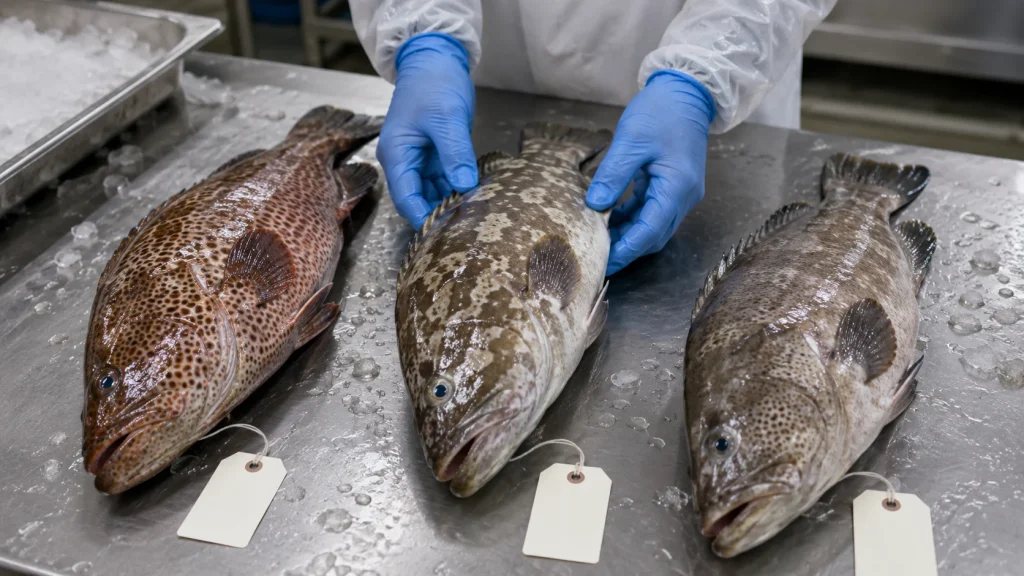
A whole grouper still has useful physical features such as body shape, coloration, skin pattern, fins, and head structure.
Once the fish is skinned, filleted, portioned, frozen, or otherwise processed, many of those features are no longer visible.
NOAA notes that seafood species become harder to identify visually once fish are filleted and skinned. It also lists the substitution of lower-value fish for grouper as one example of seafood fraud.
FDA DNA testing provides useful context because it shows that not every naming discrepancy means the same thing. In an FDA project involving 45 samples sold as grouper, 40 were considered correctly labeled under FDA naming rules. Among the remaining samples, some were different grouper species from the species declared, while others were not grouper at all.
That distinction matters. “Confusing grouper names” can describe several different situations:
| Situation | What may be happening |
|---|---|
| Several species sold as grouper | A legitimate group-level market name may be in use |
| One species has several names | Regional or commercial naming differs between markets |
| Scientific names differ | One document may use an older taxonomic synonym |
| Hybrid sold under a general grouper name | The product identity may need more detail |
| Declared species and actual species differ | It may be a specification or identification problem |
| A non-grouper species is sold as grouper | This may represent seafood substitution or mislabeling |
Treating all of these situations as the same problem can lead buyers to the wrong conclusion.
Scientific names help, but they still need to be checked carefully
Scientific names are the strongest practical reference for species identity, but they are not completely free from confusion.
Fish taxonomy changes as species are reclassified. WoRMS, for example, currently accepts Hyporthodus nigritus while recording Epinephelus nigritus as an older synonym. Similar changes exist for other grouper species.
A buyer comparing an older product specification with a newer database may therefore see two different Latin names that actually refer to the same species.
Before treating such a difference as an error, check whether one name is an accepted synonym of the other in a recognized taxonomic source.
This is particularly useful when specifications, certificates, supplier records, and customer requirements were created in different years or follow different reference databases.
What seafood buyers should verify before ordering grouper
For most commercial purchases, there is no need to memorize every grouper name. What matters is making the specification precise enough that the buyer and supplier are discussing the same fish.
At minimum, a grouper inquiry should establish:
- the commercial or commonly used product name;
- the scientific species name;
- origin or catch or production area where relevant;
- whether the fish is wild-caught or farmed;
- whether it is a species or a commercial hybrid;
- product form, such as whole, fillet, loin, portion, or another processed format;
- size, grading, packaging, and other buyer specifications;
- the naming and traceability information required by the destination market.
Photographs can also help when whole fish are being evaluated because identifying physical features are still visible.
For processed products, especially skinless fillets and portions, visual identification is less dependable. Documentation and supply-chain traceability become more important, while DNA testing can be used when stronger species authentication is warranted. Published grouper research has demonstrated DNA-based identification across different seafood product forms.
These checks also make quotations easier to compare. Two suppliers offering “frozen grouper fillet” may not be quoting comparable products if the underlying species are different.
Buy grouper by specification, not by name alone
“Grouper” remains a useful and widely understood seafood trade term, but it is not a complete product identity.
The same species may have several regional names. Several species may share the grouper name. Indonesian kerapu terminology may not map directly to the terminology used by an overseas buyer. Farmed hybrids add another layer, and accepted labeling conventions can differ between destination markets.
For B2B buyers, the practical approach is to confirm the scientific name and key product specifications before placing an order.
For suppliers and processors such as Intan Seafood in Indonesia, the same approach can reduce misunderstandings during sourcing, processing, packaging, private-label preparation, and export. Common names can remain useful, as long as everyone involved knows exactly which product they refer to.
References
- FAO Species Catalogue: Groupers of the World
- FAO Grouper Trade and Aquaculture Reference
- Australian Museum: Common Coral Trout, Plectropomus leopardus
- FDA Seafood List Guidance
- NOAA Fisheries: Seafood Import Monitoring Program
- NOAA Fisheries: Seafood Fraud
- EU Regulation No 1379/2013 on Fishery and Aquaculture Products
- World Register of Marine Species: Hyporthodus nigritus