

Yes. In most seafood trade contexts, barramundi, Asian sea bass, and the Indonesian name kakap putih refer to the same species: Lates calcarifer.
The confusion comes from the way seafood names vary between countries. A buyer in Australia may know the fish as barramundi, an Asian supplier may offer Asian sea bass, while an Indonesian supplier may call it kakap putih. The commercial names are different, but the species can be the same.
There is one important caveat. “Sea bass” on its own is a broad market term used for several different fish, while kakap can easily be interpreted as “snapper” even though Lates calcarifer is not a true snapper. For importers, distributors, retailers, and foodservice buyers, the safest way to confirm the fish is to check the scientific name rather than relying on the common name alone.
| Name | Usually refers to | What buyers should know |
|---|---|---|
| Barramundi | Lates calcarifer | Widely used commercial name, especially in Australia and international trade |
| Asian sea bass / Asian seabass | Lates calcarifer | Common in Asian aquaculture and seafood trade |
| Kakap putih | Lates calcarifer | Established Indonesian name for the species |
| Sea bass | Several different species | Too broad to confirm species identity on its own |
| Snapper | Usually fishes in the family Lutjanidae | Lates calcarifer is not a true snapper |
Why does the same fish have three different names?
Fish often have several names because commercial terminology develops separately from scientific taxonomy.
Indonesia’s Ministry of Marine Affairs and Fisheries uses kakap putih for Lates calcarifer and also identifies the species as barramundi. FishBase records kakap putih as a common name in Indonesia and Malaysia, while international biological databases also list barramundi and Asian seabass for the same species.
“Barramundi” is particularly familiar in Australia and is also used in international seafood markets. “Asian sea bass” is common in aquaculture and seafood trading across Asia, while Indonesian producers, fisheries, and domestic buyers commonly use kakap putih.
Buyers should not automatically treat these names as three different products. If supplier specifications list barramundi, Asian sea bass, and kakap putih, but each gives the scientific name Lates calcarifer, they are referring to the same currently recognized species.
That does not mean the products themselves will be identical. Origin, farming system, fish size, processing method, glaze, freezing method, cut, packaging, and other specifications may still differ.
Asian sea bass is barramundi, but “sea bass” is not always barramundi
A common mistake is to drop the word “Asian” and assume that every fish sold as sea bass is Lates calcarifer.
“Sea bass” is used commercially for several different fish. In the United Kingdom, for example, the official designation “Bass or Sea bass” applies to Dicentrarchus labrax, the European sea bass. Barramundi, Lates calcarifer, has a separate commercial designation.
The U.S. FDA Seafood List also associates Asian Seabass with Lates calcarifer, while listing Barramundi as an acceptable market name for the species.
This is why comparisons such as “barramundi vs sea bass” can be confusing. Sometimes the terms describe the same fish because “sea bass” is being used as shorthand for Asian sea bass. In other cases, the comparison is genuinely between barramundi and another species, such as European sea bass.
For procurement, “sea bass” alone is not specific enough. Check the scientific name before assuming that two products are interchangeable.
Is kakap putih a type of snapper?
Despite the name, kakap putih is not classified as a true snapper.
Current taxonomy places Lates calcarifer in the family Latidae. True snappers belong to a different family, Lutjanidae, which includes many species in the genus Lutjanus.
This distinction can become blurred in Indonesia because kakap appears in the common names of several commercially important fish. Translating every fish with kakap in its name simply as “snapper” can therefore produce inaccurate English product descriptions.
The issue is more than linguistic. A 2025 molecular authentication study examining 24 products marketed as snapper in Yogyakarta and Surakarta detected several species substitutions, including Lates calcarifer. The researchers suggested that local naming practices, including the use of kakap putih, may contribute to confusion.
Because the study covered a small number of products in only two Indonesian cities, its findings should not be used to estimate a national mislabeling rate. However, it does show why common names alone may be insufficient when exact species identity matters.
For international buyers, translating kakap putih literally as “White Snapper” may create even more confusion. Using “Barramundi (Lates calcarifer)” or another destination-appropriate commercial name makes the species much clearer.
What does barramundi look like?
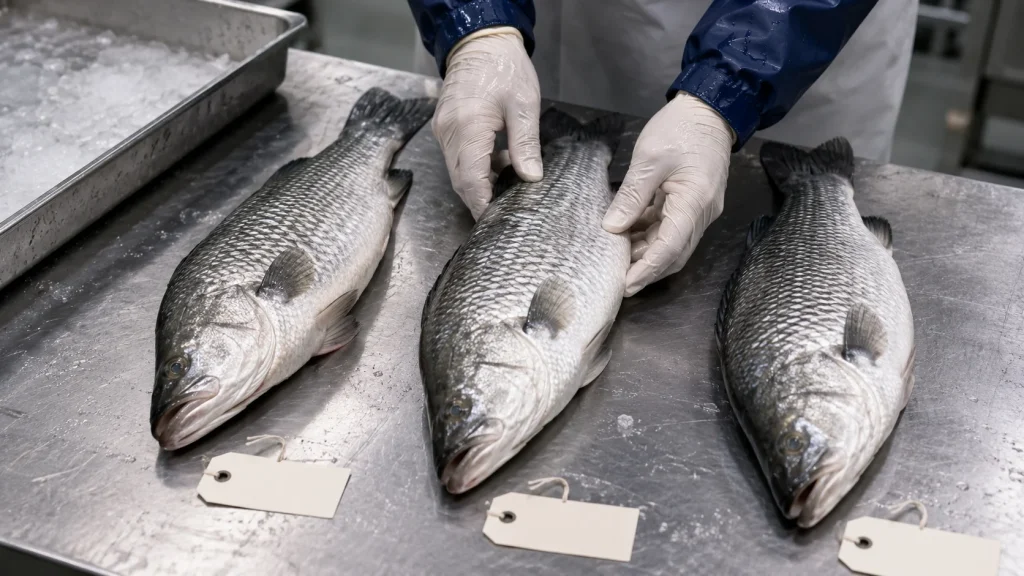
A whole barramundi has an elongated body, a pointed head, a noticeably concave forehead, a large mouth, large scales, and a rounded tail. FAO describes its coloration as ranging from olive-brown to green or blue on the upper part of the body, with silvery sides.
Color alone is not a reliable way to identify the species because its appearance can vary.
Barramundi can also resemble other large, perch-like fish. The Australian Museum, for example, notes similarities with Nile perch that may require features such as scale counts and body proportions for reliable identification.
Identification becomes more difficult after processing. A whole fish still has features such as the head, fins, scales, body shape, and lateral profile. A skinless frozen fillet, portion, cube, or other processed product removes many of those visual clues.
For B2B buyers purchasing processed frozen fish, documentation and traceability are therefore more useful than trying to identify the species by the appearance of a fillet. DNA-based methods can also be used when formal species authentication is necessary. The U.S. FDA maintains reference barcode data for Lates calcarifer for this purpose.
Freshwater barramundi and marine Asian sea bass can be the same species
Production environment is another possible source of confusion.
Barramundi is a euryhaline fish, which means it can tolerate a wide range of salinity. FAO records Lates calcarifer in freshwater rivers, estuaries, coastal waters, and aquaculture systems operating under different salinity conditions.
One supplier may therefore describe a product as farmed barramundi from a freshwater or low-salinity production system, while another offers Asian sea bass raised in coastal cages. Those descriptions do not necessarily indicate different species.
Production environment is better treated as a separate product characteristic.
For commercial purchasing, buyers should distinguish species identity from production specifications. Two products can both be Lates calcarifer while differing in origin, culture method, harvest size, fat characteristics, processing, freezing, and final product format.
Are barramundi from Indonesia and Australia biologically identical?
They are currently classified as the same species, but populations from different regions are not genetically uniform.
A 2024 whole-genome study found three major genetic lineages of Lates calcarifer, corresponding broadly to the Indian subcontinent, Southeast Asia, and Australasia. Researchers also identified additional population structure within those groups.
This does not mean Indonesian and Australian barramundi should currently be treated as separate commercial species. Taxonomic authorities such as the World Register of Marine Species continue to recognize Lates calcarifer as one accepted species.
For most seafood purchasing decisions, origin and product specification are more useful distinctions than the genetic differences between regional populations.
The finding does help explain why fish sold under the same species name may show regional biological variation. Being the same species does not mean every population, farm, harvest, or finished product will have exactly the same characteristics.
Which name should be used on seafood products?
There is no single commercial naming rule that applies to every destination market.
A name commonly understood in Indonesia may not be the appropriate labeling name in an export market. Likewise, a term used informally between buyers and suppliers may not meet the official commercial designation requirements for retail products in another country.
For example, the U.S. FDA Seafood List identifies Barramundi as an acceptable market name for Lates calcarifer and Asian Seabass as a vernacular name. FDA guidance warns that vernacular names listed for cross-reference are generally not acceptable market names for interstate commerce.
The United Kingdom also lists Barramundi as the commercial designation for Lates calcarifer, separately from European sea bass.
For exporters, product identity and legal labeling are related but separate issues. “Asian sea bass” may communicate the species clearly between trading partners, while the final retail label may require a different approved designation depending on the destination.
Suppliers and buyers should therefore confirm the labeling requirements in the market where the product will ultimately be sold.
What should seafood buyers verify before ordering?
When sourcing barramundi or kakap putih, confirming the common name is only the starting point.
The scientific name, Lates calcarifer, is the clearest identifier. Once that is confirmed, buyers can compare the commercial specifications that determine whether the product suits their market.
These may include:
- country and production origin;
- wild or farmed production where applicable;
- whole fish, fillet, loin, portion, or other processing form;
- skin-on or skinless specification;
- size or weight grade;
- freezing and glazing requirements;
- packing configuration;
- private label requirements; and
- destination-market labeling requirements.
This helps prevent two different sourcing mistakes.
The first is assuming that barramundi, Asian sea bass, and kakap putih must be different products simply because suppliers use different names. The second is assuming that anything labeled “sea bass,” “snapper,” or a loosely translated local name must be Lates calcarifer.
For importers and distributors sourcing frozen seafood from Indonesia, requesting a specification that clearly includes the scientific name can remove much of that uncertainty before comparing sizes, cuts, packaging, and other commercial requirements.
So, are barramundi, Asian sea bass, and kakap putih the same fish?
In the usual Indonesian and international seafood context, yes. Barramundi, Asian sea bass, and kakap putih commonly refer to Lates calcarifer.
The scientific name is what removes the ambiguity.
“Sea bass” without “Asian” can refer to other species, and kakap putih should not be mistaken for a true snapper simply because kakap is sometimes translated that way. Even when two products are confirmed as Lates calcarifer, buyers still need to compare origin, production method, processing form, size, packaging, and destination-market labeling.
For B2B seafood sourcing, the more useful question is not only what the fish is called, but which scientific species and product specification that name represents.
References
- Indonesia Ministry of Marine Affairs and Fisheries – Kakap Putih/Barramundi
- FAO – Cultured Aquatic Species Information Programme: Barramundi
- FishBase – Common Names of Lates calcarifer
- World Register of Marine Species – Lates calcarifer
- UK Government – Commercial Designations of Fish
- U.S. FDA Seafood List – Lates calcarifer
- Marine and Freshwater Research – Population Genetic Structure of Lates calcarifer
- U.S. FDA – Seafood DNA Barcode Reference for Lates calcarifer