

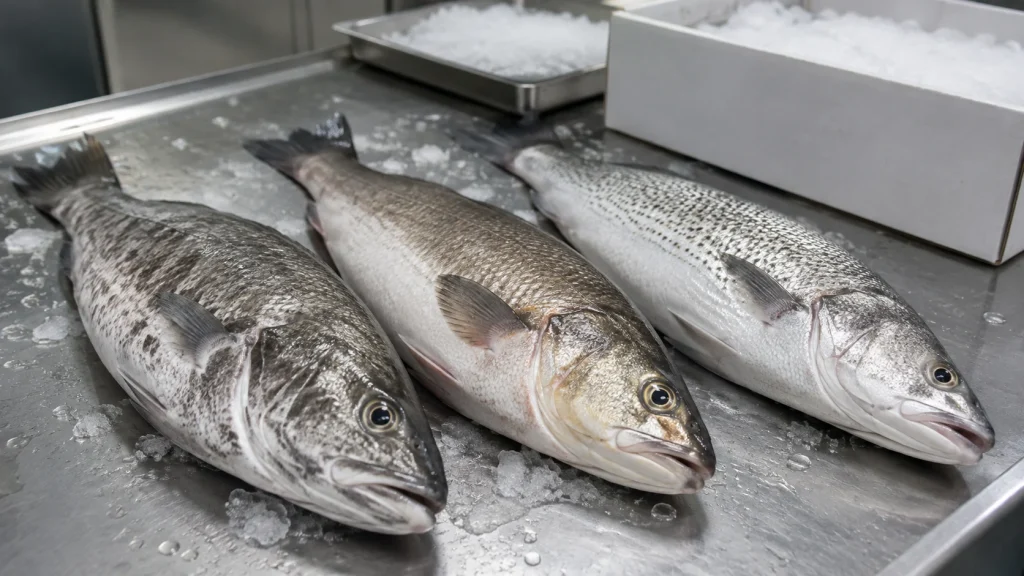
If you receive a seafood quotation for “corvina,” the name alone may not tell you exactly which fish you are buying.
Corvina is a common and commercial name used for several different fish, most of them in the drum and croaker family Sciaenidae. The species associated with the name can vary by country, fishing region, and destination market.
For seafood importers, distributors, retailers, and foodservice buyers, this can create confusion. Two suppliers may both offer corvina while supplying fish from different genera, different oceans, and different fisheries.
The safest way to identify the product is to look beyond the name “corvina.” Check the scientific name, origin, production method, size specification, product form, and destination-market labeling requirements before comparing offers.
Corvina is a market name, not a single species
Corvina is not a scientific species name.
In many Spanish- and Portuguese-speaking markets, the term is used for members of Sciaenidae, a large family that includes croakers, drums, weakfish, and related species. Different countries, however, apply “corvina” to different members of that family.
The U.S. Food and Drug Administration’s Seafood List shows how broad the naming can be. Its database allows “Corvina,” either alone or alongside names such as “Croaker” or “Weakfish,” for several species, including Cilus gilberti, Cynoscion albus, Cynoscion reticulatus, Cynoscion othonopterus, Cynoscion parvipinnis, Cynoscion virescens, and Micropogonias furnieri.
This does not mean that all sciaenids are corvina or that all fish sold as corvina are interchangeable. The term has developed as a regional market name rather than a globally standardized species identity.
For buyers, that distinction matters because the species can affect expected size, flesh characteristics, fishing area, availability, regulatory naming, sustainability information, and product specifications.
Which fish are commonly sold as corvina?
There is no single global answer. Several species are associated with the name in different markets.
| Market or region | Species commonly associated with “corvina” | Notes |
|---|---|---|
| Spain | Argyrosomus regius | Usually sold simply as “corvina”; known in English as meagre |
| Brazil | Micropogonias furnieri | Commonly known as corvina in Brazilian fisheries |
| Chile | Cilus gilberti | Official fisheries sources use corvina for this species |
| Peru | Cilus gilberti and, in some contexts, other species | Usage can vary between authorities and fisheries |
| Mexico | Cynoscion othonopterus | Known as curvina golfina in the Gulf of California |
| Indonesia / Indo-West Pacific trade | Protonibea diacanthus may be marketed as corvina | Common English name includes blackspotted croaker |
These examples show why buyers should not assume that corvina from Spain, Brazil, Mexico, and Indonesia refers to the same fish.
The species are different and, in some cases, belong to different genera.
Corvina in Spain usually means Argyrosomus regius
Spain is one of the clearer examples of a market where the name has a relatively specific commercial meaning.
Spain’s official 2026 list of commercial fish names assigns “Corvina” to Argyrosomus regius. In English, the species is generally called meagre.
The same Spanish list distinguishes several other fish using modified names such as corvina africana, corvina asiática, corvina bronce, corvina naranja, corvina negra, and corvina pintada.
The European Union’s commercial fish-name database also shows how strongly seafood names depend on language and national convention. Argyrosomus regius may be sold as corvina in Spain and Portugal, while other European countries use different commercial names for the same species.
For international seafood trade, the name used in the country of origin may therefore differ from the name recognized or accepted in the destination market.
In Latin America, “corvina” can mean several other species
The variation becomes even clearer across Latin America.
In Brazil, federal fisheries sources use “corvina” for Micropogonias furnieri, commonly known in English as whitemouth croaker. Brazilian fishery-management measures are published using this species-name pairing.
In Chile, official fisheries records use corvina for Cilus gilberti.
Mexico uses the closely related spelling “curvina” in the name curvina golfina for Cynoscion othonopterus. This species is associated with the Gulf of California fishery, for which Mexican authorities regulate allowable catches.
Peru shows that common names can vary even within one country. FONDEPES materials identify Cilus gilberti as corvina and have published technical information related to its aquaculture.
However, some regional fisheries documents in Peru use “corvinilla” for Cilus gilberti while using “corvina” for Cynoscion phoxocephalus.
This inconsistency is one reason commercial names should not be treated as a substitute for scientific identification.
What does corvina mean in Indonesian seafood trade?
For buyers sourcing from Indonesia, the species behind the name may be different from those commonly encountered in European or Latin American markets.
Intan Seafood’s 2026 product catalogue identifies its Corvina product as Protonibea diacanthus.
This species is commonly known in English as blackspotted croaker and belongs to Sciaenidae. Its natural distribution covers a broad part of the Indo-West Pacific, including areas of the Indian Ocean and Southeast Asia.
The EU commercial-name database records Protonibea diacanthus under names including corvina pintada in Spanish and corvina-pintada or corvina-prata in Portuguese.
This difference matters for international buyers. Someone familiar with Spanish corvina may expect Argyrosomus regius, while an Indonesian supplier may be offering Protonibea diacanthus.
Both names can make sense within their respective markets, but they do not refer to the same fish.
Why the scientific name matters when buying corvina
A scientific name gives buyers something a broad market name cannot: a precise species identity.
Consider five groups or species that may be associated with corvina in different parts of the world:
- Argyrosomus regius
- Protonibea diacanthus
- Cilus gilberti
- Micropogonias furnieri
- various Cynoscion species
These fish can differ in distribution, maximum size, fishery, availability, production method, and commercial positioning.
For example, Mediterranean Argyrosomus regius is both wild-caught and farmed and can reach large sizes. Protonibea diacanthus is an Indo-West Pacific coastal species associated with tropical and subtropical waters. Cynoscion othonopterus, meanwhile, is closely tied to the Gulf of California fishery.
A buyer comparing quotations without checking the scientific names could therefore be comparing different raw materials under the same commercial name.
For procurement purposes, the product description should ideally include the scientific species name alongside the commercial name.
“Corvina” may not be an acceptable label in every destination market
Commercial seafood naming can also be a regulatory issue.
A product may be known as corvina in its country of origin while the destination market requires or recognizes another name.
The United States provides a clear example. The FDA Seafood List sets out acceptable market names and common names for seafood sold in U.S. interstate commerce.
For Protonibea diacanthus, the FDA currently lists “Croaker” as the acceptable market name and “Blackspotted Croaker” as the common name. It does not list “Corvina” as the acceptable market name for that species.
At the same time, the FDA permits Corvina for several other species, including some Cynoscion species and Micropogonias furnieri.
This does not make corvina universally correct or incorrect. The acceptable name depends on the species and the market where the product will be sold.
An exporter selling an Indonesian product internationally should therefore distinguish between a regional trade name and the name accepted for labeling in the destination country.
Corvina is not the same as Chilean sea bass
Another source of confusion is the use of “sea bass” in restaurant and retail terminology.
Some corvina species may be described informally as sea-bass-like fish because of their culinary uses or market positioning. That does not make corvina another name for Chilean sea bass.
The FDA identifies Chilean sea bass as either Dissostichus eleginoides, the Patagonian toothfish, or Dissostichus mawsoni, the Antarctic toothfish.
Neither species belongs to Sciaenidae.
For product specifications and international trade, names such as corvina, croaker, sea bass, meagre, weakfish, and toothfish should not be treated as interchangeable unless the scientific species has been confirmed.
Why generic descriptions of corvina can be misleading
Consumer articles often describe corvina as a single mild white fish with a particular flavor, texture, or cooking use.
That description may be reasonable when the writer is clearly referring to one regional species. It becomes misleading when applied to every fish sold as corvina.
Different species sold under the name may vary in body size, fat content, fillet dimensions, flesh texture, processing yield, and availability.
The same issue applies to sustainability claims. Sustainability assessments are generally tied to a species, fishing area, fishery, gear type, or aquaculture system. They cannot reliably be assigned to the word “corvina” without knowing which fish and source are being discussed.
Price comparisons can also be misleading. A quotation for farmed Argyrosomus regius from the Mediterranean and one for wild Protonibea diacanthus from Southeast Asia are not automatically comparable simply because both products are called corvina.
Common names can create traceability problems
Common-name ambiguity can also affect seafood traceability.
A DNA-barcoding study of seafood sold in Mexico reported an overall seafood mislabeling rate of 30.8%. In the study sample, commercial names including curvina or corvina were among those with particularly high rates of substitution or mislabeling.
This finding should not be taken as evidence that corvina products are generally fraudulent. It does, however, show why broad market names can become difficult to verify once fish is filleted, portioned, frozen, or otherwise processed to the point that visual identification is harder.
For B2B buyers, traceability should therefore go beyond the commercial name printed on a carton.
Documentation that consistently links the product to its scientific name, origin, processing specification, and lot information provides a stronger basis for checking what is being supplied.
What should buyers check before ordering corvina?
When sourcing corvina for distribution, retail, foodservice, or further processing, the commercial name should be only one part of the specification.
At minimum, buyers should confirm:
- scientific species name
- country of origin
- capture area or farming origin
- wild-caught or farmed status
- product form, such as whole round, gutted, fillet, portion, or steak
- size or weight grade
- frozen format and packaging specification
- destination-market labeling name
The scientific name is especially useful when comparing suppliers. It allows purchasing teams to confirm whether quotations refer to the same fish before comparing price, yield, size, certification, packaging, or logistics.
Importers should also verify the accepted commercial name in the destination country before labels or retail packaging are finalized.
So, what does corvina actually mean?
Corvina is best understood as a regional seafood trade name used for several fish, mainly within the drum and croaker family Sciaenidae.
In Spain, it commonly refers to Argyrosomus regius. In Brazil, it can mean Micropogonias furnieri. Chile uses the name for Cilus gilberti, Mexico has curvina species in the genus Cynoscion, and Indonesian suppliers may use corvina for Protonibea diacanthus.
For everyday menu use, the common name may be enough. For seafood procurement, importing, processing, private label, or regulatory labeling, the scientific name provides the more reliable identification.
When a supplier offers corvina, confirm the scientific name first. That makes it much easier to verify what fish is being supplied and whether it matches the requirements of your market.
References
- FDA Seafood List
- FDA Guidance for Industry: The Seafood List
- Spain Official Commercial Species List 2026
- European Commission Fish Commercial Names Database: Protonibea diacanthus
- Brazilian Institute of Environment and Renewable Natural Resources: Marine Fishing Closures
- Mexico CONAPESCA: 2026 Curvina Golfina Catch Volumes
- FONDEPES: Larval Culture Protocol for Corvina, Cilus gilberti
- Seafood Mislabeling Study in Mexico