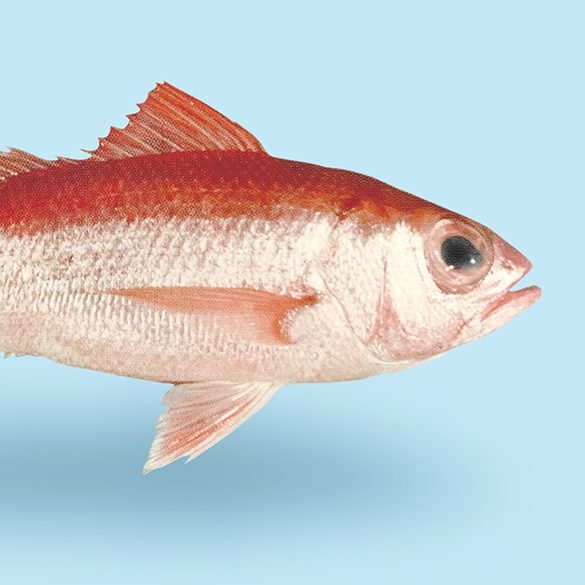


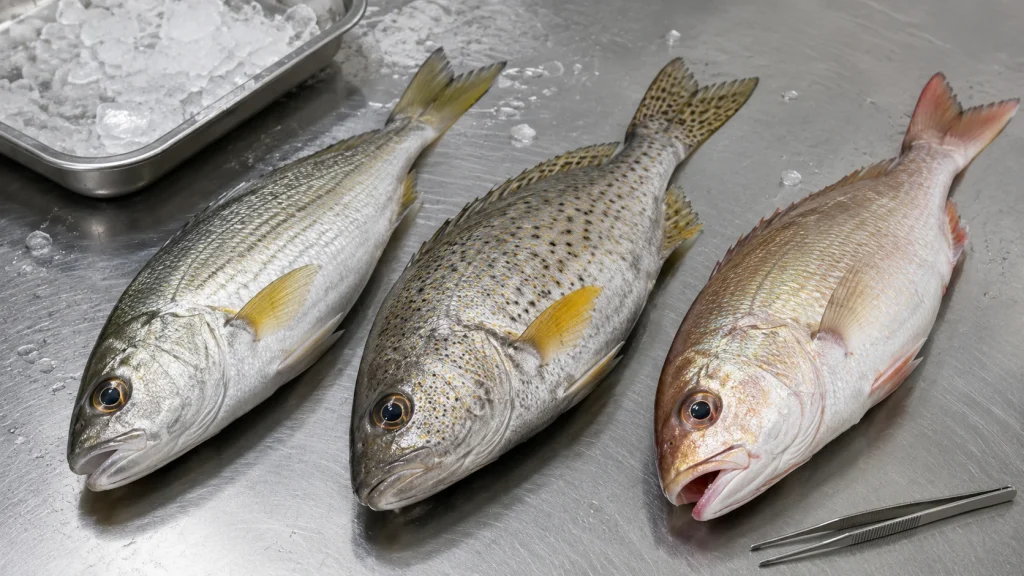
If a seafood specification simply says “croaker fish,” it may not tell you exactly which fish you are buying.
Croaker is a name used for many related species in the family Sciaenidae. In some markets, the word mainly refers to one familiar local species. In international seafood trade, however, the same name can appear on products from different genera, caught in different regions, and sold under different naming systems.
For consumers, this may be little more than a naming confusion. For importers, distributors, retailers, and foodservice businesses, the distinction can affect product specifications, sourcing, labeling, size expectations, and communication with suppliers.
The safest approach is to treat “croaker” as a broad common or commercial name unless the scientific species name is also provided.
Croaker is a fish family, not a single species
Croakers belong to the family Sciaenidae, a diverse group that includes roughly 300 recognized species across around 69 genera, according to FishBase.
Members of this family occur in marine, brackish, and freshwater environments. They are found in many parts of the world, including the Atlantic, Indo-Pacific, and Asian river systems.
The family includes fish known as croakers, drums, corvinas, weakfishes, jewfishes, meagre, and other regional names.
The word “croaker” comes from a characteristic shared by many members of the family: their ability to produce sounds. Sciaenids commonly use specialized muscles associated with the swim bladder to make croaking or drumming noises, particularly during reproductive behavior.
This shared biological feature helps explain why many different species have similar English common names. It does not mean they are the same species or can always be treated as interchangeable products.
Why one name can refer to many different fish
Common seafood names develop through a mix of biology, local fishing traditions, language, regulation, and trade.
Scientific taxonomy aims to give each recognized species a specific name. Commercial markets do not always work at that level of precision.
A supplier may use a broad trade name that customers already recognize. A local fishing community may use one name for several similar-looking fish. A national regulator may also allow several species to share the same acceptable market name.
This creates several naming layers at the same time:
- “Sciaenidae” identifies the biological family.
- “Croaker” may refer broadly to members of that family.
- “Atlantic croaker” refers to Micropogonias undulatus.
- “Tigertooth croaker” refers to Otolithes ruber.
- “Large yellow croaker” refers to Larimichthys crocea.
- A commercial label that says only “croaker” may cover more than one accepted species, depending on the market.
For an international seafood buyer, those distinctions matter more than the English common name alone.
Seafood regulations also show how broad the name can be
The U.S. Food and Drug Administration’s Seafood List provides a useful example of how commercial naming can differ from strict species identification.
The FDA recognizes “Croaker” as an acceptable market name for multiple fish species. These include Atlantic croaker (Micropogonias undulatus), Belanger’s croaker (Johnius belangerii), tigertooth croaker (Otolithes ruber), blackspotted croaker (Protonibea diacanthus), silver croaker (Pennahia argentata), yellowfin croaker (Umbrina roncador), and large yellow croaker (Larimichthys crocea), among others.
Some species can also appear under more than one acceptable market name. Micropogonias furnieri, for example, may be marketed as either “Croaker” or “Corvina” under the FDA system.
This does not mean every country follows FDA naming rules. The Seafood List applies specifically to the U.S. regulatory context.
It does show that even within a formal seafood naming system, one market name does not necessarily correspond to one biological species.
The meaning of “croaker” changes by region
Geography strongly influences which species people mean when they use the word.
On the Atlantic and Gulf coasts of the United States, “croaker” often refers specifically to Atlantic croaker, Micropogonias undulatus. In that regional context, the shortened name works because fishermen, buyers, and consumers commonly understand which fish is being discussed.
The same assumption does not work globally.
In East Asian seafood markets, large yellow croaker, Larimichthys crocea, has substantial commercial importance. FAO data have documented large-scale aquaculture production of the species, particularly in China.
In South and Southeast Asia, several other members of the Sciaenidae family enter commercial fisheries.
Indian fisheries research, for example, has documented many sciaenid species from genera including Johnius, Otolithes, Nibea, Pennahia, and Protonibea. Depending on the area, these fish may be described using English names such as croaker, jewfish, or grunter alongside regional vernacular names.
A buyer searching for “croaker fish” in one country may therefore encounter a completely different species from a buyer using the same term elsewhere.
Indonesia has several different croaker species
The distinction is particularly relevant in Indonesia, where several members of the Sciaenidae family occur in commercial catches.
Indonesian fisheries literature has recorded species including Belanger’s croaker (Johnius belangerii), leaftail croaker (Johnius trachycephalus), soldier croaker (Nibea soldado), and tigertooth croaker (Otolithes ruber).
Local Indonesian names add another layer of variation. Terms such as gulamah, tetet, and blamo may be used for fish within this broader group, depending on the species and location.
International buyers, meanwhile, may encounter broader English product descriptions.
Indonesia’s Ministry of Marine Affairs and Fisheries reported “Frozen Croaker Fish” among major Indonesian fishery commodities exported to China based on 2025 trade data. As a trade description, the term identifies a product category, but it does not by itself establish which sciaenid species is in a shipment.
Buyers working with Indonesian seafood suppliers should therefore distinguish between the commercial product name and the scientific species identification.
Even closely related croakers can be difficult to distinguish
The naming issue is not only a matter of casual terminology. Some croaker species are genuinely difficult to tell apart.
A study published in 2025 described Johnius javaensis as a newly recognized croaker species from southern Java. Specimens collected through fish-market surveys in Java, Bali, and Lombok had previously been identified as Johnius heterolepis.
Researchers distinguished the new species by examining characteristics including chin barbels, fin rays, gill rakers, swim-bladder structures, otolith morphology, and mitochondrial COI DNA sequences.
The case shows how much biological diversity can sit behind a simple seafood name. If closely related species sometimes require detailed morphological examination or DNA analysis to distinguish scientifically, a short commercial name such as “croaker” cannot be expected to provide precise species identification.
Processing makes visual identification harder
Species identification becomes even more difficult after seafood has been processed.
A whole fish may still show useful characteristics such as its mouth shape, chin structures, fins, coloration, body proportions, lateral line, and other anatomical features.
Once the fish is headed, skinned, filleted, portioned, or frozen into processed products, many of those identifying features disappear.
The FDA maintains its Regulatory Fish Encyclopedia partly to support seafood species identification and help detect substitution. When visual identification is insufficient, validated methods can use DNA barcoding based on the mitochondrial COI gene.
Most commercial buyers do not need to perform laboratory testing themselves. The practical point is that visual appearance or a general trade name should not be the only basis for identifying a processed seafood product.
Supplier documentation becomes more important as recognizable physical features are removed during processing.
Why species identification matters to seafood buyers
If two suppliers both offer “frozen croaker,” the products may still differ in meaningful ways.
Species can affect typical body size, product dimensions, geographic origin, availability, appearance, and how well the fish fits a buyer’s processing or market requirements.
A buyer sourcing whole fish may care about average piece size and external appearance. A processor purchasing raw material for filleting may focus more on yield, consistency, and processing specifications. An importer may also need the correct species information for product documentation and the naming requirements of the destination market.
For that reason, product specifications should go beyond the word “croaker” whenever species identity matters.
A clearer product description might include:
- scientific name;
- commercial or local product name;
- country or fishing origin;
- wild-caught or farmed status, where relevant;
- product form, such as whole round, headed and gutted, fillet, or portion;
- size or grading specification;
- frozen format and packaging requirements.
A specification such as “Otolithes ruber, Indonesia, whole frozen” is much more precise than “frozen croaker.”
Common name, market name, and scientific name are different
Seafood terminology is easier to follow once these three concepts are separated.
A scientific name identifies a taxonomic species using a genus and species combination, such as Otolithes ruber.
A common name is a widely used descriptive name, but its meaning can vary by language and region.
A market name is the name accepted or commonly used when seafood is sold. Regulators may define which market names are permitted within their jurisdiction.
The FDA Seafood List explicitly separates scientific names, acceptable market names, common names, and vernacular names. Some vernacular names are not considered acceptable for U.S. labeling because they may cause products to be misidentified or misbranded.
Other countries have their own systems, so an FDA-approved seafood name should not automatically be treated as a universal international standard.
FAO’s ASFIS system also shows how fisheries data can operate at different taxonomic levels. Statistical records may refer to individual species, while some categories represent a genus, family, or broader taxonomic group.
For buyers and researchers, that means it is worth checking what a name actually represents before using fisheries statistics or commercial data to describe a specific croaker species.
Do all croakers have the same characteristics?
No.
Descriptions of “croaker fish” can become misleading when characteristics from one species are presented as if they apply to every croaker.
Different species can have different distributions, maximum sizes, preferred habitats, production systems, and commercial roles.
Atlantic croaker from the western Atlantic should not automatically be treated as equivalent to large yellow croaker from East Asian aquaculture, tigertooth croaker from Indo-Pacific fisheries, or one of the several Johnius species found around Indonesia.
The same caution applies to statements about taste, texture, average size, fishing season, nutrition, or market value.
Some characteristics may be similar because the species are related, but a reliable commercial description should identify which species the information refers to.
What should you check when sourcing croaker fish?
For everyday retail situations, a common name may be sufficient. For B2B seafood sourcing, species-level clarity is more useful.
Ask the supplier which scientific name corresponds to the product being offered. Then confirm whether the species, origin, product format, size range, and processing specification match your market requirements.
For imported or exported seafood, check the naming and documentation rules that apply in the destination market rather than assuming one country’s seafood terminology applies everywhere.
This is particularly relevant when sourcing from a biologically diverse region such as Indonesia. A seafood processor or exporter may handle several demersal species that fall under similar English commercial categories, while international customers may require different specifications for each market.
For businesses working with suppliers such as Intan Seafood, discussing the scientific species name together with cut, size, packaging, origin, and quality requirements can help reduce ambiguity before production or shipment.
Croaker is useful as a name, but it is not a complete identification
“Croaker” is not an incorrect seafood name. It is simply broader than many buyers realize.
The term can refer to members of the Sciaenidae family, appear in the common names of individual species, and function as a commercial market name for multiple species. Which fish it means depends heavily on region, trade practice, and regulatory context.
When exact species matters, especially for procurement, processing, export, or product specifications, do not rely on “croaker” alone.
Check the scientific name, origin, product form, and supporting documentation. Those details provide a much clearer picture of what is actually being supplied than the common name by itself.
References
- FishBase – Family Sciaenidae
- U.S. FDA Seafood List
- U.S. FDA – Guidance for Industry: The Seafood List
- U.S. FDA – Regulatory Fish Encyclopedia
- FAO – Fishery and Aquaculture Statistics Methods and Standards
- Central Marine Fisheries Research Institute – Sciaenid Species Research
- Garuda – Indonesian Fisheries Research on Croaker Species
- Scientific Description of Johnius javaensis from Southern Java